Category Archives: Bible Doctrine

Why Do I Still Struggle With Sin? Saved by Grace, Still at War. Galatians 5:17, Romans 8:1

Saved by Grace, but Why Do I Still Struggle With Sin?

You came to Christ. You were born again. You love the Lord, you read His Word, and you want to please Him. And yet the old battles are still there. Anger still rises. Temptation still knocks. Pride still pushes back against surrender. Somewhere in the middle of that fight, a quiet question begins to rise in the heart: if God truly saved me, why do I still struggle with sin?

Many sincere believers carry that question in silence. They smile in church while privately fighting exhausting battles, because they assume mature Christians no longer wrestle with weakness. But Scripture speaks with remarkable honesty about this war.

The Flesh Remains

Paul writes, “For I know that in me (that is, in my flesh,) dwelleth no good thing” (Romans 7:18). Notice his precision. He does not say there is no good thing in Christ, or that the believer has no hope. He identifies the flesh. Even after salvation, the flesh itself remains fallen.

That is why Christians sometimes feel a tension they can hardly explain. The inward man longs for God, yet the flesh still gravitates toward self. “For the flesh lusteth against the Spirit, and the Spirit against the flesh: and these are contrary the one to the other: so that ye cannot do the things that ye would” (Galatians 5:17).

John includes himself when he writes, “If we say that we have no sin, we deceive ourselves, and the truth is not in us” (1 John 1:8). Scripture leaves no room for sinless perfection in this present life.

The Struggle Is Evidence of New Life

Before salvation, many people lived with little true resistance against sin. The flesh ruled without challenge. But after salvation, the Spirit of God begins producing conviction where comfort once existed. The believer who once justified sin now grieves over it. The heart that once ignored God now longs for fellowship with Him.

That conflict can feel painful, but it reveals something important: the Spirit is at work. Dead hearts do not war against sin out of a renewed desire to please God. This does not excuse compromise, and it does not mean every person who struggles belongs to Christ. But it does explain why sincere believers grow weary in battles that unbelievers barely notice.

The Cry of a Warring Saint

Few passages describe this inward struggle more honestly than Romans 7. “For the good that I would I do not: but the evil which I would not, that I do” (Romans 7:19). These are not the words of a man who loves sin. Paul is not celebrating disobedience. He is mourning the conflict.

Then he cries out, “O wretched man that I am! who shall deliver me from the body of this death?” And he answers in the very next breath: “I thank God through Jesus Christ our Lord” (Romans 7:24-25). The answer to the war within is not a method or more willpower. It is a Person, Jesus Christ.

There is a profound difference between struggle and surrender. A believer at war may stumble while still grieving sin, repenting sincerely, and continuing to pursue Christ. That is a very different place from a heart that has made peace with sin and stopped fighting.

Sin No Longer Reigns

Salvation changes more than outward behavior. It changes belonging. “For sin shall not have dominion over you: for ye are not under the law, but under grace” (Romans 6:14). Notice the word dominion. Sin may still fight fiercely, but it no longer reigns as master the way it once did.

Before salvation, the sinner lives comfortably beneath sin’s authority. After salvation, the believer finds himself at war against what once ruled him freely. The flesh does not disappear overnight, but ownership has changed. You belong to Christ.

Conviction Is Not Condemnation

“There is therefore now no condemnation to them which are in Christ Jesus, who walk not after the flesh, but after the Spirit” (Romans 8:1). Notice what the verse does not say. It does not say believers never fail or never need repentance. It says there is no condemnation for those who are in Christ.

Conviction and condemnation are not the same thing. Conviction says, “This is wrong. Come back to the Father.” Condemnation says, “You have failed again. Stay away.” One leads toward restoration, and the other leads toward hiding. Ever since the garden, when “Adam and his wife hid themselves from the presence of the LORD God” (Genesis 3:8), sin has pushed people to hide.

Peter knew this pain. After denying Christ three times, “the Lord turned, and looked upon Peter… And Peter went out, and wept bitterly” (Luke 22:61-62). Yet Jesus did not cast him away. Beside the sea, He asked him three times, “Lovest thou me?” and restored the disciple who had failed. “For whom the Lord loveth he chasteneth” (Hebrews 12:6). Conviction is an expression of God’s mercy toward His children.

Run Toward God, Not Away From Him

When you stumble, do not hide behind silence, excuses, or religious performance. Run back to the Father. “If we confess our sins, he is faithful and just to forgive us our sins, and to cleanse us from all unrighteousness” (1 John 1:9).

Watch what you feed your heart. Many believers spend hours on entertainment, news, and endless digital noise, then wonder why temptation feels stronger and spiritual hunger fades. What the heart consistently feeds upon eventually shapes the inner life. “This I say then, Walk in the Spirit, and ye shall not fulfil the lust of the flesh” (Galatians 5:16). Give the Word and prayer the first place in your day.

If you need someone to pray with you and open the Word of God with you, the Marriage Hotline 911 is free and available 24 hours a day at 951-444-5165. One spouse calls at a time, and husbands speak with husbands and wives with wives.

Conclusion

If you are saved by grace and still at war, you are not alone, and you are not forgotten. The struggle is real, but so is the victory in Christ. “Being confident of this very thing, that he which hath begun a good work in you will perform it until the day of Jesus Christ” (Philippians 1:6). Jesus Christ is the answer, and the Bible is our instruction manual. Keep fighting, keep repenting, and keep running to Him.


Saved by Grace, Still at War by Joe Soares

Recommended Bible Study

Saved by Grace, Still at War

Why do Christians still struggle with sin after salvation? This Scripture-centered book explores the believer’s ongoing battle with the flesh, the assurance found in Christ, and how to walk in victory without falling into either despair or self-righteousness.

View on Amazon

Continue Growing in God’s Word

Find more Scripture-centered books for your faith, your marriage, and your home, along with music and free study resources that keep pointing you back to Jesus Christ.

Books for Marriage & Faith
Music & Resources at JoeSoaresMusic.com

Banner: What Does Biblical Submission Really Mean? A glowing cross with the words: Not weakness. Not inferiority. The humble, willing heart of Christ.

What Does Biblical Submission Really Mean?

Few words in the Bible stir up more argument than submission. The world hears it and thinks of control, inferiority, or silence. Some churches have misused it, and many hurting people have been told it means something God never said. So what does biblical submission really mean?

The answer begins not with husbands or wives, but with the Lord Jesus Christ Himself. When we see submission the way Scripture shows it, we find that it is not weakness at all. It is the very shape of Christ’s own life.

Submission Begins With Christ

Jesus is fully God, yet He willingly submitted to the Father. “For I came down from heaven, not to do mine own will, but the will of him that sent me” (John 6:38).

Paul calls every believer to share that same mind: “Let this mind be in you, which was also in Christ Jesus: Who, being in the form of God, thought it not robbery to be equal with God: But made himself of no reputation, and took upon him the form of a servant, and was made in the likeness of men: And being found in fashion as a man, he humbled himself, and became obedient unto death, even the death of the cross” (Philippians 2:5-8).

Christ was not less than the Father because He submitted. Scripture shows equality and order side by side: “But I would have you know, that the head of every man is Christ; and the head of the woman is the man; and the head of Christ is God” (1 Corinthians 11:3). Submission in the Bible is never about worth. It is about God’s order.

Every Believer Is Called to Submit

Submission is not a burden placed on one group of people. It is the posture of every Christian. “Submit yourselves therefore to God. Resist the devil, and he will flee from you” (James 4:7).

Inside the church, all of us are to take the lower place: “Submitting yourselves one to another in the fear of God” (Ephesians 5:21). Peter says the same: “Yea, all of you be subject one to another, and be clothed with humility: for God resisteth the proud, and giveth grace to the humble” (1 Peter 5:5). Before a single word is said to wives, every believer is called to bow.

What Scripture Asks of Wives

God gives wives a clear instruction: “Wives, submit yourselves unto your own husbands, as unto the Lord. For the husband is the head of the wife, even as Christ is the head of the church: and he is the saviour of the body. Therefore as the church is subject unto Christ, so let the wives be to their own husbands in every thing” (Ephesians 5:22-24).

Notice the words “as unto the Lord.” A wife’s submission is first an act of worship toward Christ. It is offered “as it is fit in the Lord” (Colossians 3:18). Peter describes the beauty God sees in it: “the ornament of a meek and quiet spirit, which is in the sight of God of great price” (1 Peter 3:4).

What Scripture Asks of Husbands

The same passage gives husbands an even heavier charge: “Husbands, love your wives, even as Christ also loved the church, and gave himself for it” (Ephesians 5:25). “So ought men to love their wives as their own bodies. He that loveth his wife loveth himself” (Ephesians 5:28).

Biblical headship is not a throne. It is a cross. Jesus said, “For even the Son of man came not to be ministered unto, but to minister, and to give his life a ransom for many” (Mark 10:45). A husband leads by serving, protecting, and laying down his own preferences. “Husbands, love your wives, and be not bitter against them” (Colossians 3:19). He is to honor her “as being heirs together of the grace of life; that your prayers be not hindered” (1 Peter 3:7).

What Submission Is Not

Submission does not mean a wife is worth less than her husband. “There is neither Jew nor Greek, there is neither bond nor free, there is neither male nor female: for ye are all one in Christ Jesus” (Galatians 3:28). Husband and wife stand equal before God.

Submission never means obeying a command to sin. When men demanded disobedience to God, the apostles answered, “We ought to obey God rather than men” (Acts 5:29). No husband has authority to lead his wife away from Christ.

Why Submission Is Strength

It takes no strength to insist on your own way. It takes the strength of the Holy Spirit to lay your will down before God. “In quietness and in confidence shall be your strength” (Isaiah 30:15).

When a husband loves like Christ and a wife honors him as unto the Lord, the home becomes a living picture of the gospel: Christ giving Himself for His church, and the church gladly following Him. That is not weakness. That is the strongest marriage there is.

Living It Out This Week

Begin with your own heart before God. Ask the Lord where pride has made you resist His order. Husbands, look for one specific way to serve your wife sacrificially this week, without announcing it. Wives, look for one way to honor your husband’s leadership as unto the Lord. Pray together if you can, even briefly, and ask God to make your home a picture of Christ and His church.

If you need someone to pray with you and open the Word of God with you, the Marriage Hotline 911 is free and available 24 hours a day at 951-444-5165. One spouse calls at a time, and husbands speak with husbands and wives with wives.

Conclusion

Biblical submission is not control, silence, or inferiority. It is the humble, willing heart of Jesus Christ, who submitted to the Father all the way to the cross. Every believer submits to God, husbands love and lead like Christ, and wives honor their husbands as unto the Lord. Jesus Christ is the answer, and God’s Word is our instruction manual. When we follow His design, we find His strength.

Submission Is Not Weakness by Joe Soares

Recommended Bible Study

Submission Is Not Weakness

A biblical call to strength through obedience in marriage. This book confronts the world’s view of submission and reveals the strength found in humility, order, and surrender to God.

View on Amazon Free Workbook

Continue Growing in God’s Word

Find more Scripture-centered books for your faith, your marriage, and your home, along with music and free study resources that keep pointing you back to Jesus Christ.

Books for Marriage & Faith Music & Resources at JoeSoaresMusic.com

Banner: What Does the Bible Really Say About Hell? A glowing cross shines through the darkness with the words: Hell is real and it is forever. Jesus Christ is the way of escape.

What Does the Bible Really Say About Hell?

Few subjects make people as uncomfortable as hell. Many would rather not think about it at all, and some churches have quietly stopped mentioning it. Others have decided that a loving God could never send anyone there. So the question is worth asking plainly: what does the Bible really say about hell?

The answer may surprise you. The person in the Bible who spoke about hell more often than anyone else was not an angry prophet. It was the Lord Jesus Christ Himself, the same Savior who said, “Come unto me, all ye that labour and are heavy laden, and I will give you rest” (Matthew 11:28). If we want to know the truth about hell, we need to listen to Him.

Jesus Spoke About Hell Plainly

Jesus never treated hell as a figure of speech or a scare tactic. He spoke of it as a real place and warned people to take it seriously. “And fear not them which kill the body, but are not able to kill the soul: but rather fear him which is able to destroy both soul and body in hell” (Matthew 10:28).

He used some of the strongest language in all of Scripture to describe it. “And if thy hand offend thee, cut it off: it is better for thee to enter into life maimed, than having two hands to go into hell, into the fire that never shall be quenched: Where their worm dieth not, and the fire is not quenched” (Mark 9:43-44). Jesus was not teaching people to harm their bodies. He was teaching that nothing in this life is worth losing your soul over.

In Luke 16, Jesus described a rich man who died and woke up in torment. “And in hell he lift up his eyes, being in torments, and seeth Abraham afar off, and Lazarus in his bosom” (Luke 16:23). The man was fully conscious, he remembered his life, and he could not cross over to comfort. Jesus told this account so that the living would listen while there is still time.

Hell Is Real, and It Is Forever

One of the most sobering truths in Scripture is that hell does not end. When Jesus described the final judgment, He used the same word for the punishment of the lost as for the life of the saved. “And these shall go away into everlasting punishment: but the righteous into life eternal” (Matthew 25:46). If the life of the believer is everlasting, so is the punishment of the one who rejects Christ.

Jesus also told us who hell was first made for. “Depart from me, ye cursed, into everlasting fire, prepared for the devil and his angels” (Matthew 25:41). Hell was not prepared for people. It was prepared for the devil. Those who go there go because they refused the way of escape God provided.

The apostle Paul described it as separation from the presence of the Lord: “Who shall be punished with everlasting destruction from the presence of the Lord, and from the glory of his power” (2 Thessalonians 1:9). And the Bible’s final picture of judgment is just as clear: “And whosoever was not found written in the book of life was cast into the lake of fire” (Revelation 20:15).

Why Would a Loving God Allow Hell?

Many people stumble here. If God is love, how can hell exist? The Bible answers by showing us both the holiness of God and the seriousness of sin. “For all have sinned, and come short of the glory of God” (Romans 3:23), and “the wages of sin is death” (Romans 6:23). A holy and just God cannot simply ignore evil. If He did, He would not be good.

Yet the same God takes no delight in anyone being lost. “As I live, saith the Lord GOD, I have no pleasure in the death of the wicked; but that the wicked turn from his way and live” (Ezekiel 33:11). He is “not willing that any should perish, but that all should come to repentance” (2 Peter 3:9).

That is why the cross is the greatest display of God’s love. Rather than leave us under judgment, God sent His Son to bear it. “But God commendeth his love toward us, in that, while we were yet sinners, Christ died for us” (Romans 5:8). Hell shows us how serious sin is. The cross shows us how great God’s love is.

Who Will Go to Hell?

The Bible does not say that hell is only for murderers and the worst of sinners. Jesus said the dividing line is our response to Him. “He that believeth on him is not condemned: but he that believeth not is condemned already, because he hath not believed in the name of the only begotten Son of God” (John 3:18).

That means a person can be moral, respectable, and even religious, and still be lost. Good works cannot erase sin, and church attendance cannot replace a living faith in Christ. “And as it is appointed unto men once to die, but after this the judgment” (Hebrews 9:27). Every one of us will stand before God, and the only question that will matter is whether we belong to Jesus Christ.

How Can Anyone Escape Hell?

The good news is that no one has to go there. God has made a way, and that way is a Person. “For God so loved the world, that he gave his only begotten Son, that whosoever believeth in him should not perish, but have everlasting life” (John 3:16).

Escape from hell is not earned. It is received. “For the wages of sin is death; but the gift of God is eternal life through Jesus Christ our Lord” (Romans 6:23). It comes through repentance and faith in the Lord Jesus, who died for our sins and rose again. “That if thou shalt confess with thy mouth the Lord Jesus, and shalt believe in thine heart that God hath raised him from the dead, thou shalt be saved” (Romans 10:9).

Why This Truth Matters Today

The Bible does not teach about hell to make us cold or fearful. It teaches us so that we will run to Christ while there is still time. “Behold, now is the accepted time; behold, now is the day of salvation” (2 Corinthians 6:2). Tomorrow is promised to no one.

For the believer, this truth should also move the heart. If hell is real, then the people we love need to hear the gospel. It should make us more compassionate, more prayerful, and more willing to speak about Jesus with our families, our marriages, and our neighbors. It should also humble us, because we were saved by grace and not because we were better than anyone else.

Conclusion

So what does the Bible really say about hell? It says that hell is real, that it is forever, and that Jesus Himself warned us about it more plainly than anyone. But the Bible never leaves us there. The same Lord who warned of hell went to the cross to save us from it. Jesus Christ is the answer, and God’s Word is our instruction manual. If you have never trusted Him, do not wait. Turn to Christ today.

The Case for Hell: What Jesus Actually Taught by Joe Soares

Recommended Bible Study

The Case for Hell: What Jesus Actually Taught

If this article raised questions, this book walks carefully through the words of Jesus and what Scripture actually teaches about hell, judgment, and eternal consequences. It is written to help you see the warning clearly and to point you to the Savior who came to rescue us.

View on Amazon

Continue Growing in God’s Word

Find more Scripture-centered books for your faith, your marriage, and your home, along with music and free study resources that keep pointing you back to Jesus Christ.

Books for Marriage & Faith Music & Resources at JoeSoaresMusic.com

Going to Church While Refusing to Repent

You can sit in church every Sunday and still refuse to turn from sin.

Paul wrote of those who “have sinned already, and have not repented of the uncleanness and fornication and lasciviousness which they have committed” (2 Corinthians 12:21 KJV). His grief was over people who continued in sin without repentance.

That should cause us to examine our own lives. Have we made ourselves comfortable with something God has called us to leave behind? Are we living together outside marriage while telling ourselves it does not matter? Have we treated marriage vows, divorce, or remarriage as matters of personal preference without honestly facing what Jesus taught?

Going to church does not make disobedience acceptable to God. And knowing the right words is no substitute for turning from the sin we have defended.

If the Lord is bringing something to mind, do not push it away. Open His Word. Confess the truth to Him. Seek His help to obey, even where obedience will cost you something.

The door to repentance is open. Will you walk through it?

Examine Yourselves: A Call to Honest Faith

You can attend church, know the right words, and still make peace with sin.

Paul’s instruction is personal: “Examine yourselves, whether ye be in the faith; prove your own selves.” (2 Corinthians 13:5 KJV)

What have you begun to excuse that once convicted you? Have you persuaded yourself that God approves of something His Word calls sin? Look honestly at the choices you are making now and where they are leading.

This examination is for each of us. Bring what you find before the Lord. Confess the sin you have defended, turn from it, and ask Him to lead you in obedience.

How Can I Know If I’m Really Saved? Five Biblical Tests

How Can I Know If I’m Really Saved?

Few questions are more important than this one.

Am I truly saved?

Many people base their assurance on a prayer they once prayed, a church membership, or an emotional experience years ago.

The Bible points us somewhere better.

It points us to Christ and to the evidence of genuine faith.


1. Do You Trust Christ Alone?

Saving faith rests completely upon Jesus Christ.

“Believe on the Lord Jesus Christ, and thou shalt be saved…”
— Acts 16:31 (KJV)

Our confidence is never found in our own goodness.


2. Do You Love God’s Word?

One mark of spiritual life is a growing desire for Scripture.

No Christian is perfect, but genuine believers hunger for God’s truth.


3. Has Your Life Begun to Change?

Salvation does not produce sinless perfection.

It does produce a new direction.

God begins changing the desires of those He saves.


4. Do You Desire to Obey Christ?

Obedience never earns salvation.

Instead, it becomes the fruit of genuine salvation.

Jesus said:

“If ye love me, keep my commandments.”
— John 14:15 (KJV)


5. Is Your Confidence in Christ or Yourself?

The strongest assurance comes from looking to Christ rather than continually looking inward.

True believers continue trusting the finished work of Jesus.


Assurance Comes From God’s Word

Feelings change.

God’s promises do not.

The more we know Scripture, the stronger our assurance becomes.


Continue Studying

Recommended Bible Study

The Case Against False Conversion

If you’ve wrestled with questions about assurance, genuine conversion, or whether someone can appear to be saved while never truly knowing Christ, this book carefully examines what Scripture teaches about true saving faith.

Using the Bible as its authority, it explores repentance, false professions, assurance, and the evidence of genuine conversion—pointing readers back to Christ rather than religious tradition or emotional experiences.


View on Amazon

“Examine yourselves, whether ye be in the faith…” — 2 Corinthians 13:5 (KJV)

Can Someone Lose Their Salvation? What Does the Bible Really Say?

Can Someone Lose Their Salvation?

Few questions trouble Christians more than this one:

Can someone who has truly been saved lose that salvation?

The answer to that question affects assurance, daily Christian living, and even how we understand the Gospel itself.

Opinions are everywhere.

Churches disagree.

Teachers disagree.

But what matters is not tradition.

What matters is what God has actually said.


Salvation Is God’s Work

The Bible teaches that salvation begins with God.

“For by grace are ye saved through faith; and that not of yourselves: it is the gift of God.”
— Ephesians 2:8–9 (KJV)

If salvation is God’s work, then understanding how He preserves His people becomes incredibly important.


Jesus Gives Eternal Life

“And I give unto them eternal life; and they shall never perish…”
— John 10:28 (KJV)

Notice Jesus doesn’t say temporary life.

He says eternal life.

Yet Scripture also contains serious warnings against false professions of faith and empty religion.

That is why this subject deserves careful study rather than emotional reactions.


Real Faith Produces Real Fruit

The Bible never teaches that genuine faith produces no change.

Neither does it teach that Christians never struggle.

The issue is whether a person’s profession was genuine from the beginning.

Jesus warned repeatedly that many would claim to know Him while never truly belonging to Him.


The Importance of Examining Scripture

This is one of the most misunderstood doctrines in modern Christianity.

Instead of relying on denominational traditions, believers should search the Scriptures carefully.

God’s Word is always the final authority.


Learn More

If you’re interested in a careful, Scripture-centered examination of difficult biblical questions, you may also enjoy:

He Died for All
A Biblical Examination of Christ’s Atonement and the Gospel Invitation.

Paperback |
Kindle


Continue Growing in God’s Word

If this article encouraged you, there are more Christ-centered books, songs, lyrics, and Bible resources available.

Browse Books

Visit JoeSoaresMusic.com

“Search the scriptures…” — John 5:39 (KJV)

Can God Love Someone Who Rejects Him? A Biblical Answer

The Gospel Examined
Biblical Answers to Today’s Most Important Questions

By Joe Soares

But God commendeth his love toward us, in that, while we were yet sinners, Christ died for us.

Romans 5:8 KJV

One of the hardest questions many people ask is this:

Can God truly love someone who rejects Him?

At first, the question may seem simple. Many Christians quickly answer, “Yes, God loves everyone.” But when the question is pressed deeper, some begin to struggle.

If God knows a person will reject Him, does He still love that person?

If someone refuses the Gospel, was the invitation ever truly offered to them?

If Christ died only for certain people, can we honestly say to every sinner, “God loves you, Christ died for you, and you may come to Him today”?

These are not small questions. They affect how we understand the Gospel, evangelism, prayer, and the heart of God toward sinners.

God Loved Us While We Were Still Sinners

The Bible does not say God waited for us to become lovable before He loved us.

Romans 5:8 says:

But God commendeth his love toward us, in that, while we were yet sinners, Christ died for us.

Romans 5:8 KJV

That phrase matters: while we were yet sinners.

God’s love was not shown after man cleaned himself up. It was not shown after man became worthy. It was demonstrated while man was still guilty, lost, rebellious, and helpless.

This does not mean every person will be saved. Scripture is clear that salvation is received through repentance and faith in Jesus Christ. But it does mean God’s love toward sinners is real, not imaginary.

Jesus Wept Over Those Who Rejected Him

One of the clearest pictures of Christ’s heart is found as He looked over Jerusalem.

O Jerusalem, Jerusalem, thou that killest the prophets, and stonest them which are sent unto thee, how often would I have gathered thy children together… and ye would not!

Matthew 23:37 KJV

Jesus was not speaking to people who welcomed Him. He was speaking of a city marked by rejection, rebellion, and unbelief.

Yet His words are full of grief.

“How often would I have gathered thy children together… and ye would not.”

That is not the language of indifference. That is not the language of a Savior with no concern for the lost. That is the language of genuine compassion toward those who refused Him.

God’s Invitation Is Sincere

The Gospel invitation is not a trick. It is not an empty announcement given to people for whom no provision has been made.

Jesus said:

Come unto me, all ye that labour and are heavy laden, and I will give you rest.

Matthew 11:28 KJV

The last chapter of the Bible says:

And whosoever will, let him take the water of life freely.

Revelation 22:17 KJV

The word whosoever has comforted countless sinners because it opens the door wide. No sinner who comes to Christ will ever be turned away.

Him that cometh to me I will in no wise cast out.

John 6:37 KJV

Love Does Not Remove Responsibility

Some people assume that if God loves someone, that person must automatically be saved. But Scripture does not teach universal salvation.

God’s love does not erase man’s responsibility.

God may genuinely love. Christ may sincerely invite. The Gospel may be truly offered. Yet a sinner may still refuse.

Jesus said:

And ye will not come to me, that ye might have life.

John 5:40 KJV

The problem was not that Christ was unwilling to receive them. The problem was that they were unwilling to come.

Why This Matters

If God can love only those who will finally be saved, then the Gospel invitation becomes difficult to understand.

But if God’s love toward sinners is real, then we can preach the Gospel freely, honestly, and urgently.

We can look any person in the eye and say:

God loves sinners. Christ died for sinners. You may come to Him today.

That is not emotional exaggeration. That is the message of Scripture.

A Final Word

Yes, God can love someone who rejects Him.

That truth does not make rejection harmless. It makes rejection more serious.

To reject Christ is not to reject a distant God who never cared. It is to reject the Savior who calls sinners to come, who wept over the lost, and who gave Himself as a ransom for all.

The invitation is real.

The responsibility is real.

And the Savior is willing to receive every sinner who comes to Him in repentance and faith.

Continue Studying

He Died for All book cover

He Died for All

A Biblical Examination of Christ’s Atonement and the Gospel Invitation

Examine the biblical evidence for Christ’s atonement and the sincere invitation of the Gospel in this complete book by Joe Soares.

Kindle

Paperback

Listen While You Study

Forever You Are Master cover

Forever You Are Master

Private Collection

A worship song centered on the lordship, faithfulness, and unchanging authority of Jesus Christ.

Apple Music

Spotify

iHeartRadio

Read Next

  • Did Jesus Really Die for Everyone?
  • What Does “Whosoever” Really Mean?
  • Does God Desire Everyone to Be Saved?

Continue Growing in God’s Word

If this article encouraged you, there are more Christ-centered books, songs, lyrics, and Bible resources available.

Browse Books

Visit JoeSoaresMusic.com

About the Author

Joe Soares is a Bible teacher, worship songwriter, and author whose ministry is devoted to pointing people to the authority of God’s Word. Through books, music, and Bible teaching, he seeks to encourage believers to examine every doctrine carefully in the light of Scripture and to proclaim the Gospel of Jesus Christ faithfully.

Did Jesus Really Die for Everyone?

A Biblical Look at Christ’s Atonement and the Gospel Invitation

By Joe Soares

For God so loved the world, that he gave his only begotten Son, that whosoever believeth in him should not perish, but have everlasting life.

John 3:16 KJV

Few questions strike at the heart of the Gospel more than this one:

Did Jesus Christ die for every person, or only for a select group chosen before the foundation of the world?

This is not merely a theological debate reserved for seminary classrooms. The answer shapes how we preach the Gospel, how we understand God’s love, and how a sinner hears the invitation to come to Christ.

The Gospel Begins with an Invitation

Come unto me, all ye that labour and are heavy laden, and I will give you rest.

Matthew 11:28 KJV

Notice who is invited. Not merely the righteous. Not merely those already changed. Jesus invites weary sinners to come to Him.

The final invitation in the Bible says:

And the Spirit and the bride say, Come… And whosoever will, let him take the water of life freely.

Revelation 22:17 KJV

What Does the Bible Mean by World?

John 3:16 begins with these words:

For God so loved the world…

Some suggest that world does not really mean the world. Others argue that all does not really mean all. Yet the simplest approach is often the best one: allow Scripture to speak as it is written.

Christ’s Sacrifice Is Sufficient for Every Sinner

Who gave himself a ransom for all…

1 Timothy 2:6 KJV

And he is the propitiation for our sins: and not for ours only, but also for the sins of the whole world.

1 John 2:2 KJV

The Lord is… not willing that any should perish, but that all should come to repentance.

2 Peter 3:9 KJV

These passages deserve to be read honestly before they are explained away. They do not teach universal salvation. They testify that Christ’s atoning sacrifice is sufficient for every sinner and that God’s invitation is sincerely extended to all who hear the Gospel.

Why This Matters

If Christ did not die for everyone, can the Gospel honestly be offered to everyone?

When we tell a sinner, “Christ died for sinners, and you may come to Him today,” we are declaring the wonderful invitation of God’s Word.

Him that cometh to me I will in no wise cast out.

John 6:37 KJV

Continue the Study

He Died for All book cover

He Died for All

A Biblical Examination of Christ’s Atonement and the Gospel Invitation

Examine the biblical evidence in greater depth in this complete book by Joe Soares.

Kindle

Paperback

Continue Growing in God’s Word

If this article encouraged you, there are more Christ-centered books, songs, lyrics, and Bible resources available.

Browse Books

Visit JoeSoaresMusic.com

About the Author

Joe Soares is a Bible teacher, worship songwriter, and author whose ministry is devoted to pointing people to the authority of God’s Word. Through books, music, and Bible teaching, he seeks to encourage believers to examine every doctrine carefully in the light of Scripture and to proclaim the Gospel of Jesus Christ faithfully.

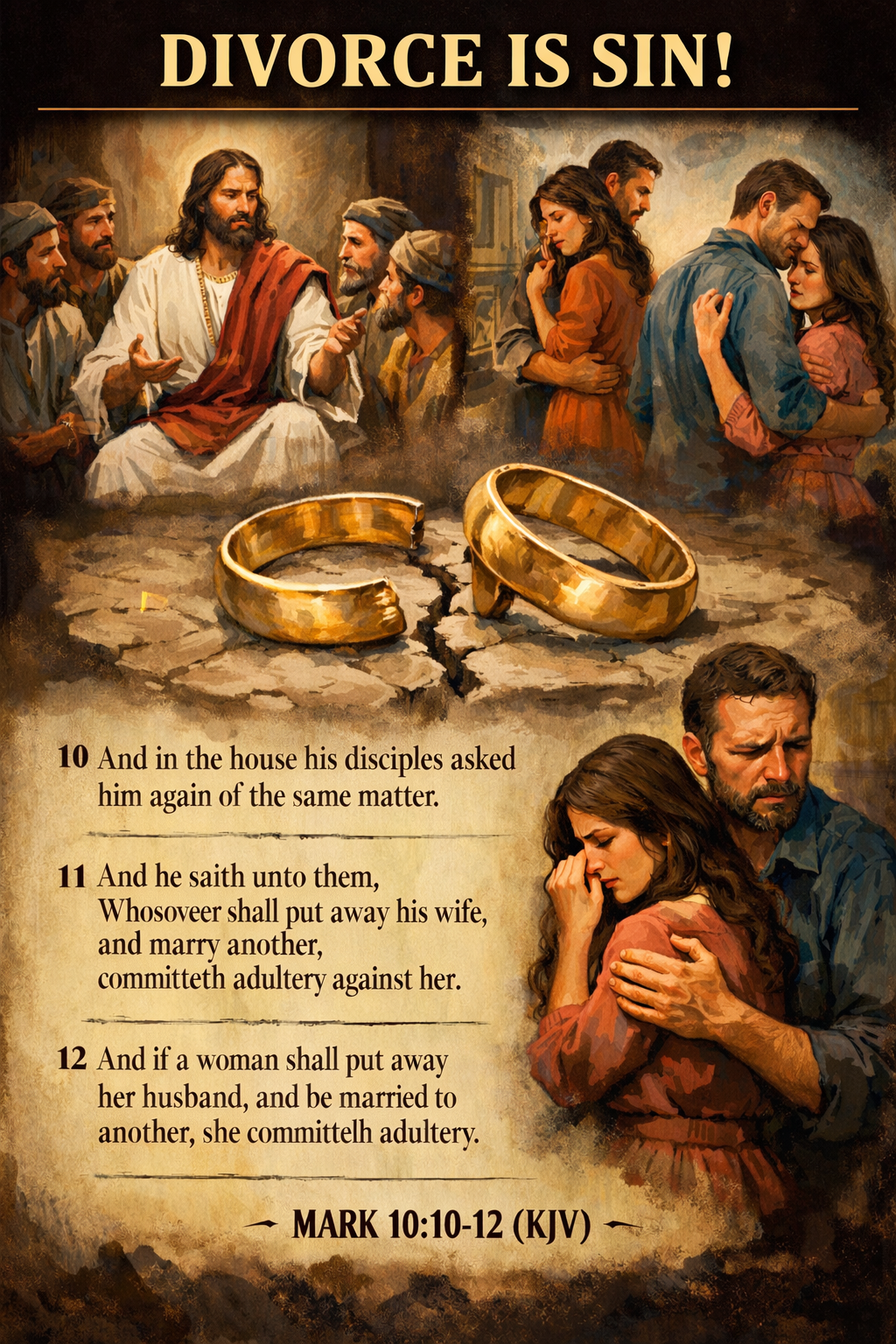
Mark 10:10–12 KJV | What Jesus Said About Divorce

Mark 10:10–12 KJV — Jesus teaches that divorce followed by remarriage results in adultery.

Mark 10:10–12 (KJV)

10 And in the house his disciples asked him again of the same matter.

11 And he saith unto them, Whosoever shall put away his wife, and marry another, committeth adultery against her.

12 And if a woman shall put away her husband, and be married to another, she committeth adultery.

Make no mistake about it.

You will not hear this in most churches today. Not because the words of Jesus are unclear, but because the truth is uncomfortable. Hard truth does not always fill seats, but it does save souls.

Jesus did not soften the truth to match the culture. In Mark 10:10–12 He plainly states that divorce followed by remarriage results in adultery.

Our modern culture has normalized what God has warned against. What used to be called sin is now called freedom. What used to be called adultery is now called starting over.

But changing the label does not change the truth.

Truth is love because it warns us before we walk toward destruction.

A culture built on feelings and pleasure will always reject God’s design. But that road leads to death, not life.

Jesus speaks the truth because He desires eternal life for our souls.

If your marriage is struggling and you need biblical help, visit: